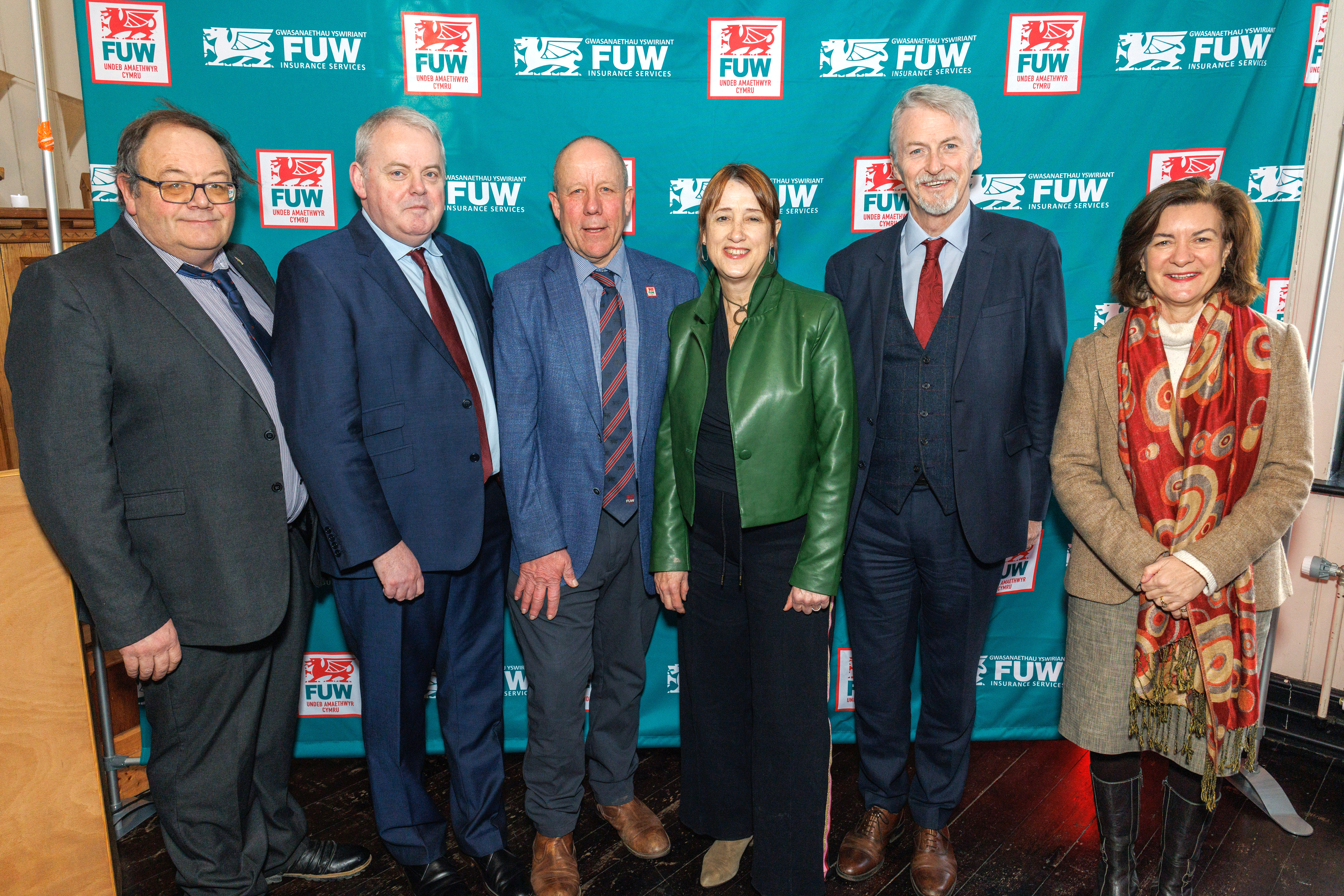
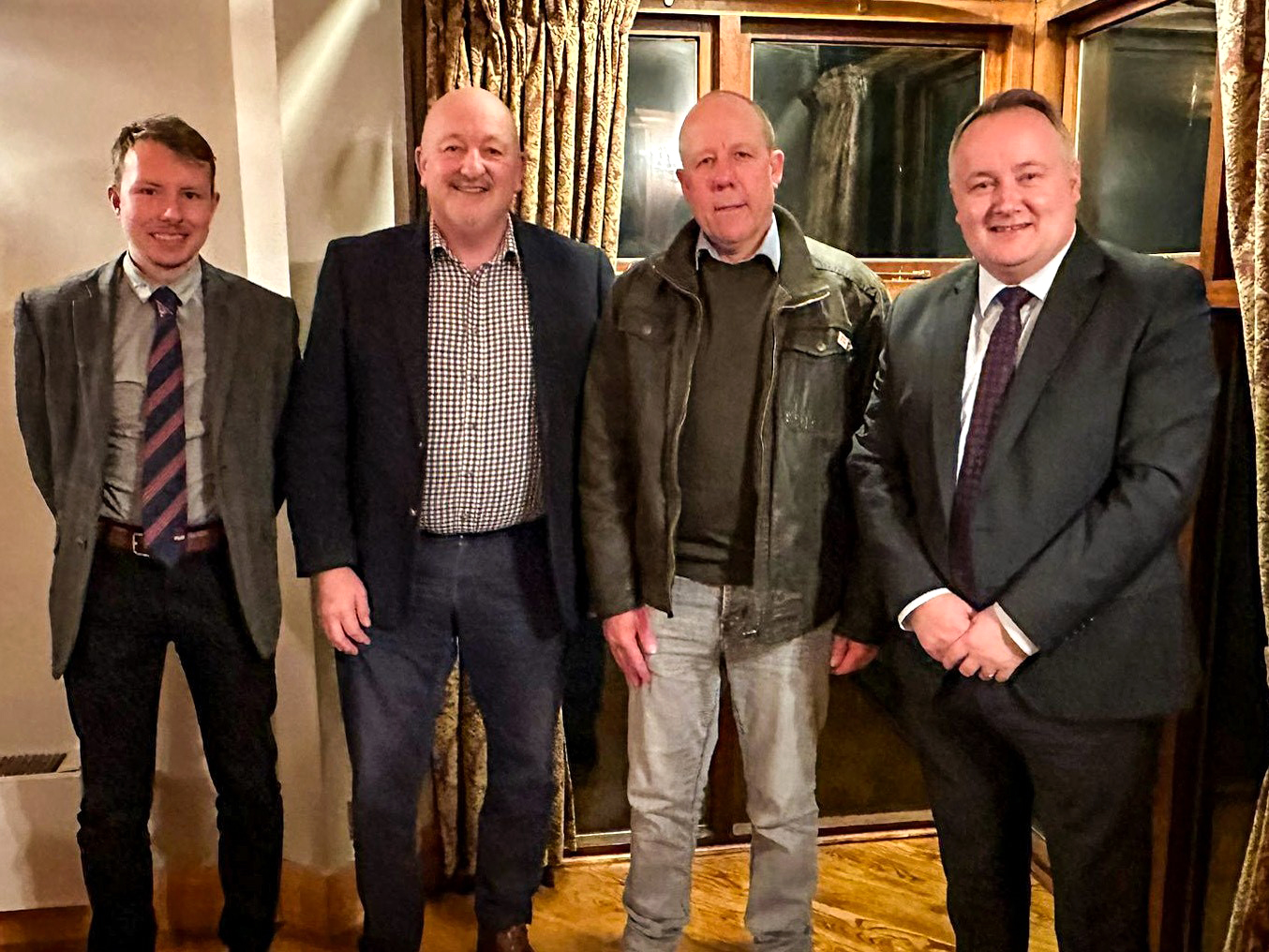
Meeting Plaid Cymru leader Rhun ap Iorwerth MS and Rural Affairs spokesperson Llyr Gruffydd MS, the Farmers’ Union of Wales (FUW) reaffirmed its key manifesto call for securing appropriate funding for the Sustainable Farming Scheme (SFS) as it moves from design to delivery.
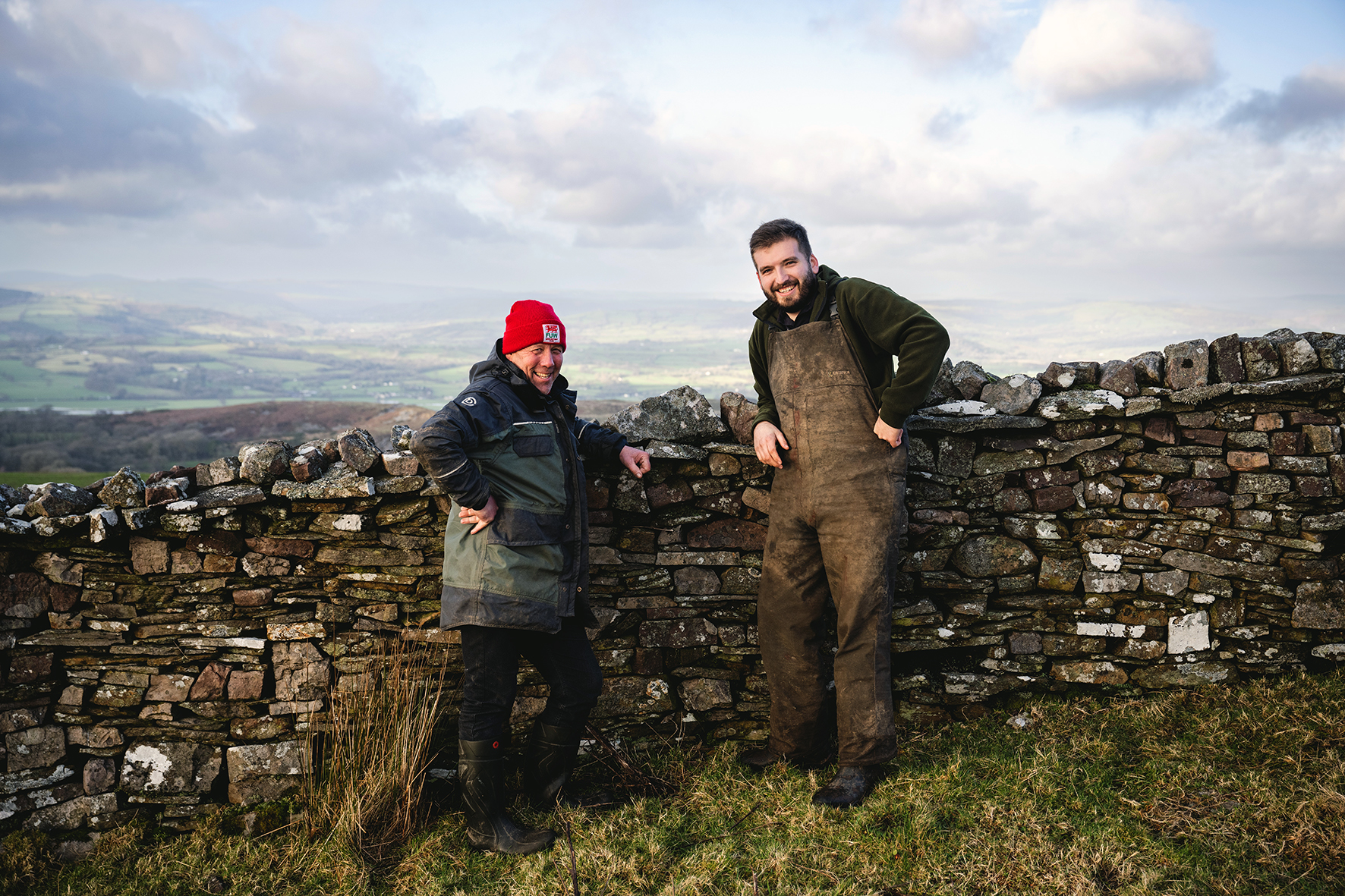
Earlier this week, FUW Regional Vice President Alun Owen, alongside his wife Marian and son Siôn, welcomed the Plaid Cymru representatives to their farm, Gallt-y-Celyn in Pentrefoelas. Gallt-y-Celyn is an upland beef and sheep farm on the Foelas estate in the Uwchaled area, sitting between 600 and 800 feet above sea level.
During the farm tour with the Owen family and visitors, discussions focused on the challenges facing Welsh farmers, including the Welsh Government’s Control of Agricultural Pollution ‘NVZ’ regulations and the implementation of the Sustainable Farming Scheme.
At a meeting following the tour, FUW President Ian Rickman and Tim Faire, Chair of FUW’s Land Use and Climate Change Committee also stressed the urgent need for a fair funding settlement that allows for at least the maintenance of annual payment rates in line with inflation for farms entering the Scheme from 2026.
In autumn, the Welsh Government published the evidence base underpinning the SFS. While improvements had been made following extensive engagement and lobbying, the impact assessments highlighted a potential reduction in livestock units and farm business income, demonstrating the need for increased funding.
As part of their 2026 Senedd Manifesto launched earlier this year, the FUW reiterated its calls for the next Welsh Government to provide adequate funding, maintain close collaboration with the farming industry, and deliver a medium-term financial framework that gives certainty to Welsh farming businesses.
As part of their manifesto calls, the Farmers’ Union of Wales are calling on the next Welsh Government to increase the base-level funding of £238 million for the Universal Layer of the SFS by an amount that fully mitigates the estimated economic impacts and supports the Scheme’s ambitions. Based on the Government’s own assessments, this would mean an increase of at least £76 million.
Commenting, FUW President Ian Rickman said:
“As the Sustainable Farming Scheme moves from design to delivery, it is crucial that existing, and future Welsh Governments provide it with an appropriate budget and financial framework. Welsh farmers need certainty and adequate support to ensure the Scheme succeeds and delivers for the environment, rural communities, and farm businesses across Wales.
As May’s crucial Senedd election approaches, we will continue to lobby and engage with politicians from all parties for a future where food production and Welsh family farms are placed firmly at the heart of government policy.”
Reflecting on the visit, FUW Regional Vice President, Alun Owen said:
"I was pleased to welcome Plaid Cymru representatives to our farm to discuss many of the changes and challenges currently facing Welsh agriculture. It’s important that politicians understand the pressures our farms face, from environmental regulations to the introduction of the Sustainable Farming Scheme.
I also welcomed the opportunity to emphasise the crucial need for a five-year financial framework for the Sustainable Farming Scheme budget, providing medium-term economic certainty for Welsh farming businesses.
“Crucially, if Welsh farmers are to invest to comply with regulatory requirements, or adapt their businesses to meet the rules of the Sustainable Farming Scheme, we need assurances from the next Welsh Government that future funding for farm support will continue to support our ability to produce sustainable food.”
The Farmers’ Union of Wales (FUW) has welcomed new legislation passed today (18 December 2025), that strengthens protections for farm animals in Wales and England against dog attacks.
Under the changes, the previous £1,000 cap on fines for livestock worrying in Wales and England will be removed, paving the way for unlimited fines, and police given powers to detain dogs believed to pose an ongoing threat to livestock.
A number of key reforms are included as part of the Dogs (Protection of Livestock) (Amendment) Act 2025, including wider police powers to seize and detain dogs suspected of attacking livestock. Police will also be able to obtain warrants to access the homes of owners of animals suspected of an offence, strengthening the ability to gather evidence and support prosecutions.
The legislation also modernises definitions of livestock and what constitutes an attack, reflecting changes in farming practices and patterns of dog ownership. For the first time, llamas and alpacas will receive the same legal protections as cattle, sheep, goats and poultry.
The Bill also clarifies that offences can occur on roads and paths, ensuring livestock remain protected while being moved along tracks and highways.
Commenting, FUW regional vice president Anwen Hughes said:
“Dog attacks inflict devastating trauma on livestock and further economic strain and stress on farmers. Beyond fatalities and severe injuries, the stress alone can trigger miscarriages in ewes and lambs can become separated from their mothers.
"The FUW has long campaigned for stronger police and legal powers to tackle dog attacks on livestock, recognising the devastating and ongoing impact these incidents have on Welsh farmers. We therefore warmly welcome the passing of this historic legislation, which represents a significant and long-overdue step forward in protecting livestock, supporting farmers, and strengthening rural communities.
"In the meantime, it remains crucial that dog owners demonstrate diligence and responsibility when out with their dogs. Dog owners should never underestimate their dog; even the most friendly and well-trained dogs have a natural instinct to chase and it's vital that owners act responsibly when outside in the countryside.”
The Farmers’ Union of Wales has awarded its 2025 FUW Lifetime Achievement Award to Terry Bayliss, recognising his long-standing contribution to the UK sheep sector and farmer-led processing initiatives.
Terry’s involvement in the agricultural industry took a significant step forward in 1998, when he and four fellow farmers established Farmers Ferry in response to poor returns for UK sheep producers. Their aim was to create a more efficient route for exporting lambs directly from farms to continental markets. By its second year, Farmers Ferry was exporting around 1.2 million lambs, quickly becoming a notable development within the sector. Terry has served as Company Director and Chairman for 27 years.
The early success of Farmers Ferry led to the formation of Farmers First, which attracted over 2,750 farmer investors, and later to the creation of Farmers Fresh in 2000, operating from a slaughterhouse in Kenilworth. This expansion provided farmer-controlled access to European markets for lamb carcasses and helped increase competition within the UK marketplace.
In 2018, the company acquired the Fairfield Meat Abattoir in Wrexham, creating Farmers Fresh Wales. Over the years, the business has navigated major sector challenges, including foot-and-mouth disease, Brexit-related uncertainty and the Covid-19 pandemic, while maintaining trade in the EU and developing new markets in the UK, Canada and the Middle East.
Terry’s contribution has been previously recognised, including receipt of the John Gittins Memorial Award in 2021 and the Royal Smithfield Club Bicentenary Trophy in 2019, for both of which the FUW provided nominations.
Presenting Terry Bayliss with the FUW’s Lifetime Achievement Award, FUW President Ian Rickman said:
“Terry Bayliss has played a significant part in developing farmer-controlled processing and marketing structures over many years. From humble beginnings to becoming a major force in the UK processing sector, the journey he helped shape is remarkable.
His commitment to supporting producer interests, and his role in strengthening market access for lamb, have made a substantial contribution to the sector and Welsh farmers. The FUW is delighted to recognise his work with this award.”
The Farmers’ Union of Wales (FUW) has again outlined its continued concerns regarding proposals to establish a new National Park in North East Wales, highlighting potential implications for farming businesses, rural communities and public services.
Following extensive engagement with members living and working within and around the proposed boundary, the FUW has submitted its latest consultation response to Natural Resources Wales, outlining a number of key concerns regarding the proposed Glyndŵr National Park.
The FUW retains concerns about the long-term funding and governance of a new National Park Authority. While funding has been proposed through Welsh Government grants and a local authority levy, members remain uncertain that this would provide sufficient stability over time, particularly in the context of ongoing pressures on public finances and the budgets of existing National Park Authorities.
The Union has highlighted the risk that additional financial responsibilities could place further pressure on local authorities and, in turn, on services relied upon by rural communities.
FUW members have expressed continued reservations about the potential impact of National Park designation on planning and development. Experience from existing designated areas suggests that development processes can be more complex and time-consuming, with implications for essential farm infrastructure, diversification and compliance with current regulations.
As farming businesses prepare for the transition to the Sustainable Farming Scheme (SFS), members are keen to ensure that any new designation does not introduce additional barriers or inconsistencies in planning policy.
The Union has also noted concerns that restrictions on on-farm renewable energy developments within some National Parks may limit opportunities to improve farm efficiency and contribute to wider environmental objectives.
Continued concerns have also been raised about the potential impact of National Park designation on local housing markets, particularly in relation to affordability for local families, young farmers and multi-generational farm businesses.
While recognising the economic value tourism can bring, FUW members have highlighted continued concerns regarding pressures on rural infrastructure in designated areas, including parking, road safety, emergency services and rural crime. Members have also expressed concern that without adequate resourcing, increased visitor numbers could exacerbate these pressures and increase costs for farming businesses.
The FUW maintains that many of the environmental and landscape objectives associated with National Park designation could be achieved through partnership approaches and existing policy mechanisms.
Tim Faire, Chair of the FUW Land Use and Climate Change Committee, said:
“There remain significant unanswered questions about how a new National Park would be funded and managed over the long term, and what the practical implications would be for farming businesses and local communities.
Many rural areas already face pressure on infrastructure and local facilities, which may struggle to cope with the additional demands that a National Park designation could bring. Further regulations and restrictions could also hinder farm development and diversification.
While we fully recognise the importance of protecting our landscapes, we believe the current National Landscape designation already provides a strong foundation. Future land management objectives are likely to be more effectively achieved through local engagement and existing policy mechanisms - without introducing another costly and complex layer of designation.”
The Union is calling on NRW and the Welsh Government to fully assess the potential socio-economic and environmental impacts before any further decisions are made in relation to the proposal.
With great sadness, early December 2025 saw the passing of renowned broadcaster, Sulwyn Thomas.
Over many decades, through his work as a journalist and presenter, Sulwyn became a close and valued friend of the Farmers' Union of Wales. He fronted a wide range of programmes, including Stondin Sulwyn, broadcasts from the Royal Welsh Show, and served as Ffermio presenter between 1997 and 2004.
As the presenter of Stondin Sulwyn on Radio Cymru, he shed light on the many challenges and changes facing rural Wales, giving significant attention to the Foot and Mouth crisis in the early 2000s. Throughout his career, he became a close friend to many Union members and officers, including the FUW stalwart - and fellow Carmarthenshire native - the late Meurig Voyle.
In 2005, the Union honoured him for his outstanding service to the rural communities of Wales, awarding him the Farmers' Union of Wales External Award for his contribution to agriculture. The Carmarthenshire branch also held a special dinner to pay tribute to him on his retirement.
Paying tribute, Brian Walters, Life Member of the Farmers' Union of Wales, said:
“Throughout his career, Sulwyn was a good friend to the Farmers' Union of Wales, just as the Union was to him. Through his programmes and his presenting, he brought the challenges, changes, and characters of farmyard and the bustle of the Showground, into homes across Wales. Our deepest condolences go to his family and friends. We thank him for his support and his wonderful company over the years.”